React Native vs. Flutter Which Framework Should You Choose in 2026
Choosing the right framework can have a major impact on the success of a mobile application. Developers want a technology that provides excellent performance, supports multiple platforms, has a strong ecosystem, and makes development as efficient as possible.
Two of the most popular choices for cross-platform mobile development are React Native and Flutter.
But which one should you choose in 2026?
The answer depends on your project’s requirements, your team’s existing skills, the type of user interface you want to build, and how much access you need to native platform capabilities.
In this detailed React Native vs Flutter comparison, we will examine both frameworks across performance, programming languages, user interface development, developer experience, ecosystem, community support, scalability, testing, and long-term project considerations.
What Are React Native and Flutter?
Before comparing them, it is important to understand what these technologies actually provide.
What Is React Native?
React Native is an open-source framework for building mobile applications using React and JavaScript or TypeScript. It allows developers to create applications for platforms such as Android and iOS while sharing a significant portion of their application code.
React Native was originally developed by Facebook, now Meta, and has become one of the most widely recognized technologies for cross-platform mobile development.
The official React Native documentation describes it as a framework for creating native applications for Android and iOS using React. Modern React Native development also provides improved support for native capabilities through its evolving architecture.
One of React Native’s biggest advantages is its connection to the broader JavaScript and React ecosystem.
What Is Flutter?
Flutter is Google’s open-source UI toolkit for building applications across multiple platforms from a single codebase.
Flutter uses the Dart programming language and provides its own widget-based UI system. Developers can create interfaces for Android, iOS, web, desktop, and other supported platforms.
Flutter’s documentation emphasizes its ability to build multiplatform applications from a single codebase while providing extensive control over the user interface.
The fundamental difference is therefore quite important:
- React Native is based around React and JavaScript/TypeScript.
- Flutter uses Dart and its own widget-based rendering approach.
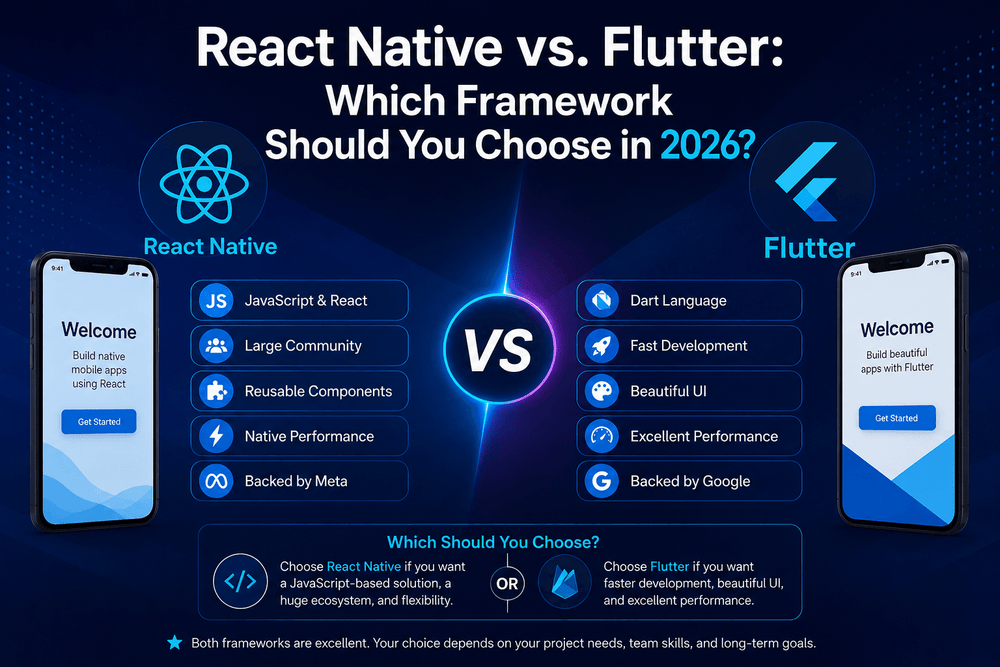
React Native vs Flutter: Quick Comparison
| Feature | React Native | Flutter |
|---|---|---|
| Primary language | JavaScript / TypeScript | Dart |
| Developer | Meta | |
| UI approach | React components + native platform components | Flutter widgets |
| Android support | Yes | Yes |
| iOS support | Yes | Yes |
| Web support | Available through React Native Web | Available |
| Learning curve | Easier for React/JavaScript developers | Moderate |
| Ecosystem | Very large JavaScript ecosystem | Strong Flutter ecosystem |
| UI customization | Excellent | Excellent |
| Native integration | Excellent | Excellent |
| Best suited for | Teams familiar with React/JS | Teams wanting a unified UI toolkit |
Neither framework is universally better. The better choice depends on what you are building.
1. Programming Language: JavaScript vs Dart
One of the first differences developers notice is the programming language.
React Native uses JavaScript or TypeScript.
Flutter uses Dart.
For a developer already working with React, JavaScript, or TypeScript, React Native can have a much smaller learning curve. The developer can reuse familiar concepts such as components, hooks, state management, and modern JavaScript tooling.
Flutter requires developers to learn Dart.
Dart is designed for application development and works particularly well with Flutter, but it is another language to add to your technical stack.
Winner: React Native for JavaScript developers
If your team already has strong React or TypeScript experience, React Native is often the more natural choice.
If your team is comfortable learning Dart or already uses Flutter, this advantage becomes much less significant.
2. Performance: React Native vs Flutter
Performance is one of the most common questions in the React Native vs Flutter debate.
Both frameworks can produce high-quality applications when they are properly designed and optimized.
Flutter uses its own rendering engine and widget system, giving developers significant control over how interfaces are rendered.
React Native has also evolved substantially. Modern React Native architecture improvements have focused on improving communication between JavaScript and native components and providing a more efficient development foundation.
However, performance is not determined by the framework alone.
Application architecture, animations, network requests, image handling, state management, unnecessary renders, memory usage, and device hardware can all affect the final experience.
For example, a poorly optimized Flutter application can perform worse than a well-designed React Native application, and the opposite can also be true.
Winner: Tie
For most normal business applications, social applications, dashboards, content platforms, and e-commerce apps, both frameworks can provide excellent performance.
For highly specialized applications involving intensive graphics or unusual native requirements, you should evaluate the specific technical requirements before choosing.
3. User Interface and Design
Flutter is particularly strong when it comes to highly customized interfaces.
Its widget-based architecture gives developers extensive control over the visual appearance of an application.
Instead of depending heavily on native UI components, Flutter provides a comprehensive set of widgets that can be customized to create consistent interfaces.
React Native takes a different approach.
React Native components are designed to provide a native application experience, while developers can also use additional libraries and native components when they need more customization.
For applications that closely follow platform-specific design conventions, React Native can be a very good fit.
For applications where the same highly customized interface must look almost identical across Android and iOS, Flutter can be attractive.
Winner: Flutter for highly customized cross-platform UI
Flutter has a particularly strong advantage when pixel-level consistency across platforms is a major requirement.
4. Development Speed
Development speed is another important factor.
React Native benefits from the enormous JavaScript ecosystem. Developers can access thousands of libraries, tools, tutorials, and existing React knowledge.
React Native also supports fast development workflows, allowing developers to see changes quickly during development.
Flutter provides a productive development experience as well, including features such as hot reload.
Both technologies allow developers to rapidly iterate on an application.
The biggest productivity difference often comes from the developer’s existing knowledge.
A React developer may be significantly faster with React Native.
A Flutter developer who has spent years working with Dart may naturally be more productive with Flutter.
Winner: Depends on your team
There is no universal winner here.
Choose the framework your team already understands unless there is a strong technical reason to move in another direction.
5. Ecosystem and Libraries
React Native benefits from the massive JavaScript ecosystem.
This is a major advantage.
JavaScript has been used for web development for decades, and React has become one of the most widely adopted frontend technologies.
This means developers can often find existing packages, tutorials, integrations, and solutions for common problems.
Flutter has a strong package ecosystem as well, with packages available through pub.dev, the official package repository for Dart and Flutter.
The size and maturity of a specific package can matter more than the number of available packages.
Before adding a dependency to a production application, examine:
- Maintenance activity
- Documentation
- Compatibility
- Open issues
- Community adoption
- Security considerations
- Compatibility with your current framework version
Winner: React Native
React Native generally has the advantage because it sits within the much larger JavaScript and React ecosystem.
6. Community and Developer Support
Both React Native and Flutter have large developer communities.
React Native has benefited from the popularity of React and JavaScript, giving developers access to a huge amount of educational content.
Flutter also has a large international community supported by Google and a growing collection of tutorials, packages, documentation, and developer resources.
When choosing a framework, community size matters because developers eventually encounter problems that are not covered by basic tutorials.
A strong community makes it easier to find examples and possible solutions.
Winner: React Native
React Native’s connection to React and the JavaScript ecosystem gives it a particularly broad developer audience.
7. Native Platform Integration
Mobile applications sometimes need access to platform-specific features.
Examples include:
- Bluetooth
- Camera
- GPS
- Biometrics
- Push notifications
- Background processing
- File systems
- Sensors
- Native authentication
- Platform-specific APIs
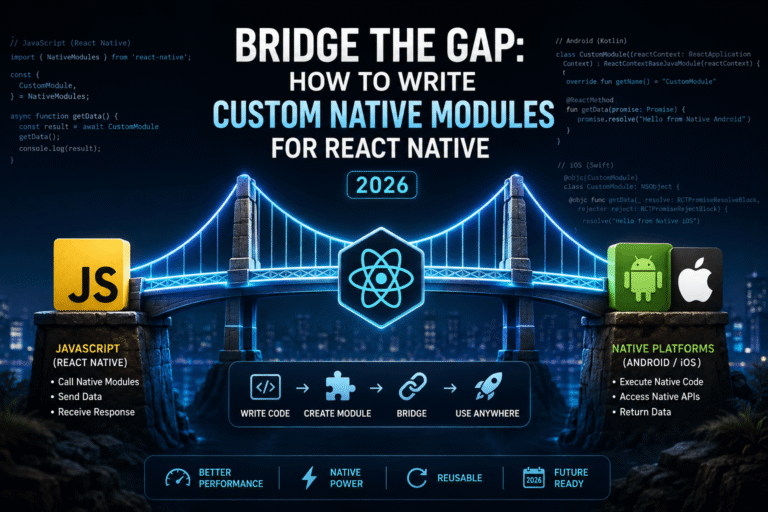
Both React Native and Flutter can communicate with native Android and iOS code.
React Native has a mature model for creating native modules and integrating platform-specific functionality.
Flutter also provides mechanisms for communicating with platform-specific code and creating plugins.
The right choice depends on the specific native feature you need.
Winner: Tie
Both frameworks are capable of handling serious mobile applications with native integrations.
8. Learning Curve
For beginners, the learning curve can influence the decision significantly.
If you already know:
- React
- JavaScript
- TypeScript
- HTML/CSS concepts
- Frontend development
then React Native is likely to feel familiar.
If you prefer Google’s ecosystem and are interested in learning Dart, Flutter can be an excellent option.
Flutter introduces concepts such as widgets, widget trees, layouts, and Dart-specific programming patterns.
React Native introduces React concepts such as components, hooks, state, props, and effects.
Winner: React Native for existing web developers
For someone starting from zero, neither is automatically easier.
Your previous programming experience matters.
9. Scalability and Large Applications
Both React Native and Flutter can be used for large applications.
However, scalability is influenced heavily by architecture rather than the framework itself.
A scalable project should have:
- Clear folder organization
- Reusable components
- Strong typing
- Predictable state management
- Automated testing
- Consistent coding standards
- Good API architecture
- Performance monitoring
- Secure data handling
React Native works particularly well for organizations already using React across their web applications.
Flutter can be attractive to companies that want a highly unified UI technology across multiple platforms.
Winner: Tie
Both can support large projects when the architecture is carefully designed.
10. React Native vs Flutter for Startups
Startups usually care about development speed, available developers, cost, and the ability to release an MVP quickly.
React Native can be an excellent option for startups that already use JavaScript or React.
A company can potentially share knowledge between web and mobile development teams.
Flutter can also be excellent for startups because a single codebase can support multiple platforms while providing extensive UI control.
The decision should be based on the startup’s existing technical skills rather than simply choosing the framework that appears most popular.
11. React Native vs Flutter for E-Commerce Apps
For e-commerce applications, both frameworks can work well.
An e-commerce application typically requires:
- Product catalogs
- Search
- Shopping carts
- User authentication
- Payments
- Push notifications
- API integration
- Order tracking
- Analytics
These features are not exclusive to either framework.
React Native may be particularly attractive if the company’s web store is already built with React and TypeScript.
Flutter can be a strong alternative when the team prioritizes a highly customized visual shopping experience.
12. React Native vs Flutter for Beginners
If you are completely new to mobile development, ask yourself one simple question:
What do I already know?
If you know React, start with React Native.
If you are comfortable learning Dart and prefer Google’s development ecosystem, Flutter is worth exploring.
Do not spend months comparing benchmarks before writing your first application.
Build something small with both technologies if you have time.
After creating a simple project in each framework, you will have a much better understanding of which development experience suits you.
React Native vs Flutter: Advantages and Disadvantages
React Native Advantages
- Uses JavaScript and TypeScript
- Excellent choice for React developers
- Huge JavaScript ecosystem
- Strong community
- Mature cross-platform development solution
- Good native integration
- Significant code sharing between platforms
React Native Disadvantages
- Some advanced features require native platform knowledge
- Third-party dependency quality can vary
- Platform-specific differences still need attention
- Performance optimization may require deeper knowledge for demanding applications
Flutter Advantages
- Excellent control over UI
- Strong widget system
- Dart is optimized for application development
- Excellent cross-platform development experience
- Consistent visual design
- Strong official tooling and documentation
- Good performance for many application types
Flutter Disadvantages
- Requires learning Dart
- Smaller ecosystem compared with the broader JavaScript ecosystem
- Some platform-specific functionality may require additional integration
- Flutter’s UI approach differs significantly from traditional web development
Which Framework Should You Choose in 2026?
So, React Native vs Flutter: which framework should you choose?
For many developers, the answer is straightforward.
Choose React Native if:
- You already know React.
- Your team uses JavaScript or TypeScript.
- You want access to the broader JavaScript ecosystem.
- You need a strong cross-platform mobile solution.
- You expect your web and mobile teams to share knowledge.
- Your application benefits from native platform components.
Choose Flutter if:
- You want extensive control over the UI.
- You are comfortable learning Dart.
- Consistent visual design across platforms is important.
- Your team prefers Flutter’s widget architecture.
- You want one toolkit for multiple application targets.
Neither choice should be based solely on online popularity.
The best framework is the one that fits your team, application requirements, budget, development experience, and long-term maintenance strategy.
Final Verdict: React Native vs Flutter
There is no single winner in the React Native vs Flutter comparison.
React Native is an excellent choice for developers and companies already invested in React, JavaScript, and TypeScript. Its mature ecosystem and connection to the broader web development world make it particularly attractive for teams that want to share knowledge between web and mobile development.
Flutter is an impressive alternative for developers who prioritize UI consistency, customization, and a unified widget-based development experience. Its Dart ecosystem and strong tooling make it capable of supporting serious cross-platform applications.
For most web developers entering mobile development in 2026, React Native is likely to be the easier starting point, especially if they already understand React.
For teams that prioritize a highly customized interface and are comfortable adopting Dart, Flutter can be an excellent choice.
Ultimately, the framework matters—but your architecture, development practices, testing strategy, security, and understanding of your users matter even more.
Frequently Asked Questions
Is React Native better than Flutter?
Not universally. React Native is particularly strong for React and JavaScript developers, while Flutter offers excellent UI control and a unified widget-based approach.
Which is faster, React Native or Flutter?
Both can deliver strong application performance. Actual performance depends on application architecture, code quality, device capabilities, rendering requirements, and optimization.
Should I learn React Native or Flutter first?
If you already know React and JavaScript, React Native is usually the most natural starting point. If you prefer Dart and Flutter’s widget-based architecture, Flutter is also a strong option.
Is Flutter still relevant in 2026?
Yes. Flutter remains an active cross-platform development technology with official documentation, tooling, and a broad ecosystem.
Is React Native still relevant in 2026?
Yes. React Native continues to be actively developed and remains an important technology for cross-platform mobile application development.
Trusted Sources
- React Native Official Documentation: https://reactnative.dev/
- Flutter Official Documentation: https://docs.flutter.dev/
- Flutter Official Website: https://flutter.dev/
- React Official Documentation: https://react.dev/
- Dart Official Documentation: https://dart.dev/
About The Author