2. Flutter State Management in 2026 Provider vs Riverpod vs Bloc
State management remains one of the most important architectural decisions when building a Flutter application. As a Flutter project grows, managing data between screens, handling asynchronous operations, updating widgets efficiently, and keeping business logic separate from the user interface can become increasingly challenging.
In 2026, Flutter developers have several mature options for managing application state. Among the most commonly discussed solutions are Provider, Riverpod, and Bloc. Each approach solves similar problems but follows a different philosophy and offers different levels of structure, flexibility, and complexity.
So, which one should you choose for a new Flutter project?
In this guide, we will compare Provider vs Riverpod vs Bloc, explain their strengths and weaknesses, examine their suitability for small and large Flutter applications, and help you decide which Flutter state management solution makes the most sense for your project in 2026.
What Is State Management in Flutter?
Before comparing libraries, it is important to understand what state management actually means.
State is simply information that can change while an application is running. Examples include:
- A user’s authentication status
- Shopping cart contents
- Theme preferences
- API responses
- Loading states
- Form values
- Selected filters
- Current chat messages
- User profile information
Flutter’s official documentation explains that applications eventually need ways to share state between screens and throughout the application. Flutter does not require developers to use one specific state-management package, which means teams can choose an approach that fits their architecture.
For a very small application, Flutter’s built-in setState() may be enough. As an application becomes larger, however, a dedicated state-management solution can make the code easier to organize, test, and maintain.
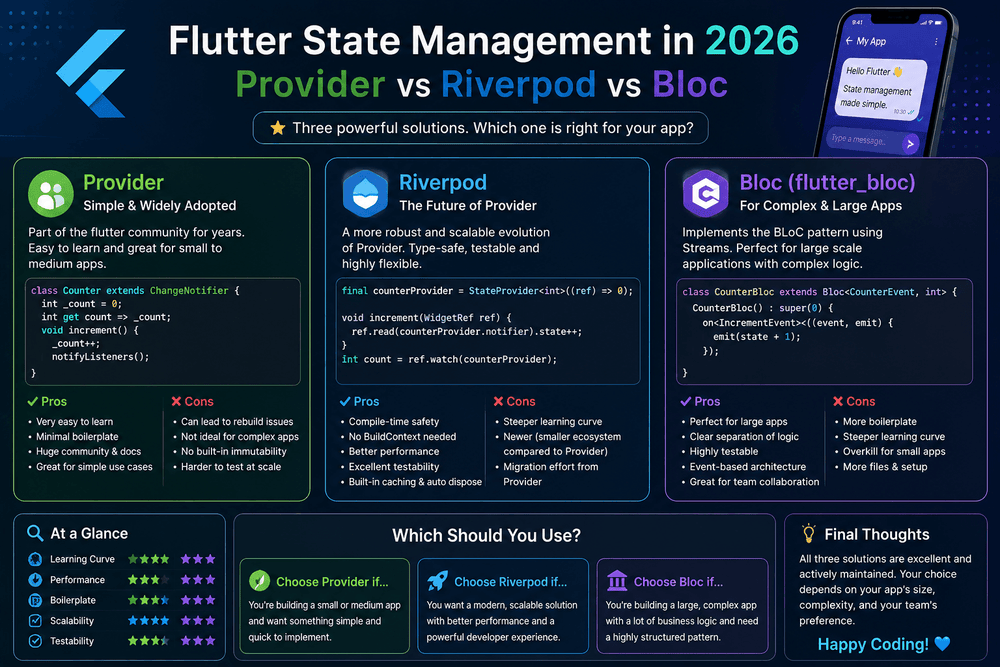
Provider vs Riverpod vs Bloc: Quick Comparison
Here is a high-level comparison:
| Feature | Provider | Riverpod | Bloc |
|---|---|---|---|
| Learning curve | Low | Medium | Medium–High |
| Boilerplate | Low | Low–Medium | Medium–High |
| Dependency injection | Good | Excellent | Good |
| Async state | Basic | Excellent | Excellent |
| Testability | Good | Excellent | Excellent |
| Large applications | Good | Excellent | Excellent |
| Architecture enforcement | Low | Medium | High |
| Flexibility | High | Very High | High |
| Beginner friendly | Excellent | Very Good | Good |
| Complex business logic | Good | Excellent | Excellent |
These categories are architectural observations rather than official benchmark scores. The best solution depends on the project’s requirements and the team’s experience.
What Is Provider in Flutter?
Provider is one of the most widely known approaches to state management in Flutter. It became popular because it provides a relatively simple way to expose objects and application state to widgets.
Provider commonly works with concepts such as:
ProviderChangeNotifierConsumercontext.watch()context.read()
A simple example might look like this:
class CounterModel extends ChangeNotifier {
  int count = 0;

  void increment() {
    count++;
    notifyListeners();
  }
}
The model can then be exposed to the widget tree and consumed by widgets that need it.
Provider’s biggest advantage is simplicity. Developers who are new to Flutter state management can understand its basic concepts relatively quickly.
Advantages of Provider
Provider is particularly attractive because:
- It is easy to learn.
- It integrates naturally with Flutter widgets.
- It requires relatively little code for simple state.
- There is a large amount of existing Flutter code using Provider.
- It works well for small and medium-sized applications.
Disadvantages of Provider
As an application grows, Provider-based architectures can become more dependent on widget-tree configuration and BuildContext.
Complex applications may also require additional patterns around dependency injection, asynchronous state, testing, and lifecycle management.
This does not make Provider a bad choice. It simply means that the simplicity that makes Provider attractive can become less convenient as architectural requirements increase.
What Is Riverpod?
Riverpod was designed as an alternative to Provider with a stronger emphasis on safety, testability, dependency management, and flexible state composition.
The official Riverpod documentation describes providers as access points to shared state and emphasizes features such as compile-time safety, testability, scalability, asynchronous state handling, and efficient listening.
One important difference is that Riverpod providers are not tied to BuildContext in the same way traditional Provider usage often is.
A basic Riverpod application requires a ProviderScope at the root:
void main() {
  runApp(
    const ProviderScope(
      child: MyApp(),
    ),
  );
}
A simple provider can then be declared:
final counterProvider = StateProvider<int>(
  (ref) => 0,
);
A widget can access it using Riverpod’s consumer APIs.
Riverpod also provides specialized mechanisms for asynchronous state and more complex application architectures.
Why Riverpod Is Popular in 2026
Riverpod has continued to evolve and now provides a broad ecosystem for managing synchronous and asynchronous application state.
The current Riverpod documentation highlights features including:
- Declarative programming
- Automatic loading and error handling
- Compile-time safety
- Type-safe parameters
- Testability
- State composition
- Pull-to-refresh support
- Custom lint rules
- Refactoring support
- WebSocket support
- Developer tooling
The current Riverpod package documentation also describes it as a reactive caching and data-binding framework designed to simplify asynchronous operations while keeping application logic separated from the UI.
Riverpod 3.x also introduces a more modern API direction compared with older Riverpod tutorials found online. For example, current documentation shows modern provider APIs and code-generation options.
This is important for developers starting a new project in 2026: older tutorials may use APIs that are no longer the preferred approach.
What Is Bloc?
Bloc stands for Business Logic Component.
The Bloc approach focuses on separating business logic from the presentation layer. Instead of allowing widgets to directly modify application state, user actions can be represented as events, which are processed by a Bloc that produces new states.
A simplified conceptual flow looks like this:
User Action
     ↓
   Event
     ↓
   Bloc
     ↓
 New State
     ↓
   UI Update
For example:
abstract class CounterEvent {}

class CounterIncremented extends CounterEvent {}
A Bloc can then react to the event and produce a new state.
Bloc’s official package describes the library as a predictable state-management solution for implementing the BLoC design pattern. The current package ecosystem includes flutter_bloc, bloc_test, and other related packages.
Advantages of Bloc
Bloc is particularly useful when an application contains complicated business rules.
Its main advantages include:
Clear separation of concerns
Business logic can be kept outside the UI.
Predictable state transitions
Events lead to state changes through a structured process.
Excellent testability
Business logic can be tested independently from widgets.
Strong architecture
Bloc encourages developers to define clear boundaries between presentation and application logic.
Suitable for large teams
A consistent Bloc architecture can make it easier for multiple developers to work on a large codebase.
Disadvantages of Bloc
The main criticism of Bloc is usually complexity.
A simple feature may require several files or concepts:
Event
State
Bloc/Cubit
Repository
Widget
For a small application with only a few pieces of state, this structure may feel excessive.
Bloc therefore tends to make more sense when the complexity of the application justifies the additional structure.
Provider vs Riverpod
Provider and Riverpod are closely related conceptually, but Riverpod addresses several limitations developers commonly encounter with traditional Provider-based architectures.
Provider
Provider is often easier for beginners.
It works naturally with Flutter’s widget tree and can be an excellent choice for straightforward applications.
Riverpod
Riverpod provides more flexibility around dependency management, asynchronous state, testing, and provider composition.
Riverpod providers can also be declared outside widgets, and the official documentation emphasizes that these providers are immutable declarations rather than mutable global state.
Which One Is Better?
For a new application in 2026, Riverpod is often the more attractive choice if you want a modern provider-based architecture with stronger tooling and asynchronous-state capabilities.
However, if you already have a stable Provider codebase, there may be no compelling reason to rewrite the entire application simply because Riverpod is newer.
Riverpod vs Bloc
This is a more interesting comparison because both are well suited to larger applications.
Riverpod focuses heavily on providers, dependency management, reactive state, and composability.
Bloc focuses more strongly on explicit events and predictable state transitions.
Consider a login flow.
With a provider-oriented approach, you might expose an authentication controller/provider that manages the login state.
With Bloc, you might model the process as:
LoginRequested
       ↓
 AuthenticationBloc
       ↓
LoginLoading
       ↓
LoginSuccess
       OR
LoginFailure
Both approaches can produce excellent applications.
The difference is primarily architectural style.
Choose Riverpod if you prefer:
- Flexible provider-based architecture
- Less ceremony
- Strong asynchronous state handling
- Dependency injection
- Composable providers
- Modern declarative patterns
Choose Bloc if you prefer:
- Explicit events
- Explicit states
- Strong separation of business logic
- Predictable state transitions
- A highly structured architecture
- Clear conventions across a large team
Provider vs Riverpod vs Bloc for Large Applications
For a large Flutter application, the most important factor is not simply which package has more features.
Architecture matters more.
A large application may contain:
- Authentication
- Payments
- User profiles
- Notifications
- Search
- Offline storage
- APIs
- Complex forms
- Real-time data
- Analytics
- Multiple teams
At this scale, state management needs to work alongside repositories, services, navigation, dependency injection, persistence, and testing.
Riverpod and Bloc are both strong candidates for this type of architecture.
Provider can also be used successfully, but teams may need to establish additional conventions as complexity increases.
Which State Management Is Easiest to Learn?
If you are completely new to Flutter state management, Provider is arguably the easiest starting point.
A typical learning path could be:
setState()
   ↓
Provider
   ↓
Riverpod / Bloc
However, there is no requirement to learn Provider before Riverpod or Bloc.
If you are starting a new project and already understand Dart, asynchronous programming, and Flutter’s widget lifecycle, learning Riverpod directly can be a reasonable approach.
Similarly, developers who prefer explicit architecture may find Bloc easier to understand conceptually once they become comfortable with events and states.
Which Is Best for Performance?
It would be misleading to declare one library universally “the fastest.”
Application performance depends on much more than the state-management package.
Important factors include:
- Widget rebuild patterns
- Number of widgets
- Data processing
- Network requests
- Database operations
- Image handling
- State granularity
- List rendering
- Application architecture
A poorly designed Riverpod application can perform badly, just as a poorly designed Bloc or Provider application can.
The better question is:
Does the state-management solution allow you to control rebuilds and structure state efficiently?
All three approaches can be used to build performant Flutter applications when implemented correctly.
Which One Should You Choose in 2026?
There is no universal winner, but the following guidelines are useful.
Choose Provider if:
- You are building a small application.
- Your state requirements are straightforward.
- Your team already knows Provider.
- You want a low learning curve.
- You do not need a highly structured architecture.
Choose Riverpod if:
- You are starting a new Flutter project.
- You want flexible dependency management.
- Your application uses asynchronous data heavily.
- You want strong testability and composability.
- You prefer a modern provider-based architecture.
- You want current Riverpod tooling and code-generation options.
Choose Bloc if:
- Your application contains complex business logic.
- You prefer explicit events and states.
- You are working with a large development team.
- You want strong architectural conventions.
- You need highly testable business logic.
- Your team already has experience with Bloc.
My Recommendation for New Flutter Projects in 2026
For many new Flutter applications in 2026, Riverpod is an excellent default choice because it combines flexible state management with dependency management, asynchronous-state support, testing capabilities, and modern tooling. The current Riverpod ecosystem also continues to evolve; for example, the current package documentation lists Riverpod 3.x releases and associated tooling.
That does not mean Bloc is outdated.
Quite the opposite: the current Bloc package remains actively maintained and provides a predictable implementation of the BLoC architecture.
Provider also remains useful, particularly for simple applications and existing projects.
The best choice should therefore be based on project complexity, team experience, architectural preferences, and long-term maintenance, rather than popularity alone.
Final Verdict: Provider vs Riverpod vs Bloc
Flutter state management in 2026 is not about finding one library that replaces everything else.
Instead, developers have several mature approaches:
Provider is simple, familiar, and suitable for straightforward applications.
Riverpod offers a flexible and modern provider-based approach with strong support for asynchronous operations, dependency management, testing, and scalable architecture.
Bloc provides a highly structured approach that works especially well for applications with complex business logic and teams that value explicit events and state transitions.
For a small Flutter project, Provider may be all you need. For many new applications, Riverpod is an excellent balance between simplicity and scalability. For large systems with complex business workflows, Bloc remains a strong architectural choice.
Ultimately, good state management is less about choosing the “most powerful” library and more about choosing a system your team can understand, test, maintain, and use consistently.
Frequently Asked Questions
Is Riverpod better than Provider in 2026?
Riverpod offers more modern capabilities around dependency management, asynchronous state, testing, and provider composition. However, Provider can still be an excellent solution for simple applications and existing projects.
Is Bloc still relevant in 2026?
Yes. Bloc remains an actively maintained state-management library with a strong ecosystem and a clear architecture based on business logic components.
Should beginners use Riverpod or Provider?
Provider generally has a gentler learning curve. However, beginners can learn Riverpod directly if they are comfortable with Flutter and Dart.
Can Riverpod replace Bloc?
For many applications, Riverpod can handle state-management and business-logic requirements that developers might otherwise implement with Bloc. However, the two libraries encourage different architectural styles, so the decision depends on the project and team.
Does Flutter require a state-management package?
No. Flutter includes built-in mechanisms such as setState(), and the official Flutter documentation presents state management as a broader architectural topic rather than requiring one specific package.
Trusted Sources
- Flutter official state-management documentation
- Riverpod official documentation
- Riverpod package documentation on pub.dev
- Bloc package documentation on pub.dev
Always check the official package documentation before starting a new project because package APIs, recommended patterns, and version requirements can change over time.
About The Author